
The Antidote of Calm: Forbearance, Deliberation, Patience, and Gentleness in Building Character and Self-Control
Professor Hassan Yachou presents calmness as a refined moral quality and a practical discipline combining forbearance, deliberation, wisdom, gentleness, and patience to support sound decisions and resilience under pressure.
Citation preview:
أكاديميحسن يشو (2021). The Antidote of Calm: Forbearance, Deliberation, Patience, and Gentleness in Building Character and Self-Control. موقع حركة التوحيد والإصلاح. https://alislah.ma/%D8%AA%D8%B1%D9%8A%D8%A7%D9%82-%D8%A7%D9%84%D9%87%D8%AF%D9%88%D8%A1-%D8%AD%D8%B3%D9%86-%D9%8A%D8%B4%D9%88/
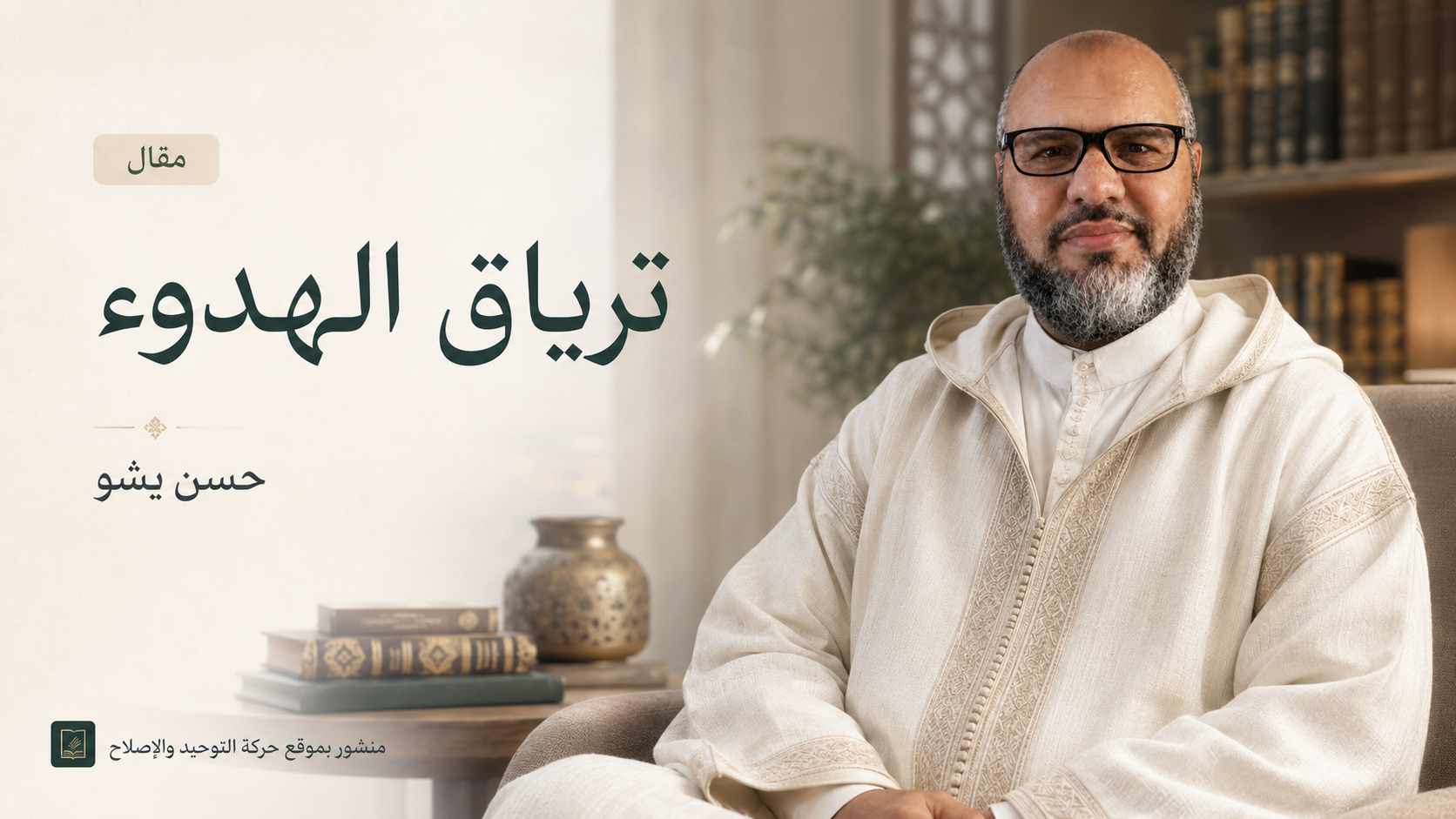
The Messenger of Allah ﷺ said to al-Ashajj of ‘Abd al-Qays: “You possess two qualities that Allah loves: forbearance and deliberation.” This Prophetic guidance frames Professor Hassan Yachou’s counsel to students of knowledge, preachers, leaders, and decision-makers: cultivate calmness together with forbearance, deliberation, reason, composure, insight, and restraint.
What calmness means
In Arabic, calmness denotes stillness after agitation, the quieting of movement and sound, and relief from fear or distress. In human conduct it means tranquillity, confidence, balance, and freedom from panic. It is not muteness, passivity, or weakness. It is a sign of awareness and inner strength: the ability to speak clearly at the right moment, to remain silent when silence is wiser, and to prevent impulsive reactions from taking command.
The student needs this quality to continue learning with consistency. Those engaged in Islamic work need it so that haste, anxiety, and emotional volatility do not damage people or noble causes. Calmness is therefore a cultivated behaviour, a mark of civilisation, and an essential condition of responsible leadership.
Calm speech, attentive listening
Do not allow the tongue to outrun the mind. Speech is most valuable when it is concise, meaningful, and supported by quiet action. Human beings have one tongue and two ears, a reminder that the ethics of listening matter as much as the ethics of speaking. A calm person listens carefully, speaks with precision, and does not need noise to prove strength.
Such composure spreads reassurance among companions and earns trust. It makes people more willing to listen, learn, and cooperate. Anger at every minor provocation, by contrast, exposes fragility even when it is hidden behind physical strength or loud rhetoric.
Calmness, happiness, and the use of time
Neither wealth nor status alone produces happiness. A more complete happiness grows from tranquillity joined to serious work. The calm person benefits from the present, learns from the past without living inside its sorrow, and prepares for the future without surrendering to fear. Noise is easy—it only requires the ability to shout—whereas calmness requires preparation, patience, and endurance.
Modern media and social platforms often reward agitation. Calmness has a quieter home: the conscience. It must be nourished repeatedly. A person may regret an angry response or reckless position, but rarely regrets deliberation and self-command.
A practical discipline under pressure
Give time to family, work, and the inner self. When duties accumulate and pressure intensifies, pause long enough for reassurance to find its way back. Calmness reduces stress, interrupts exhausting routine, restores focus, and protects decisions from confusion. It allows talent to grow in stillness while character grows through responsible engagement with life.
Look gratefully at the filled part of the cup, then work quietly to fill what remains. Set aside moments before dawn for reflection, reading, worship, and planning. The Qur’an describes the recitation at dawn as witnessed. Such periods of solitude restore balance and renew the energy needed for a difficult road.
Optimism also calms the nerves in severe moments. Even when the sea stood before Moses and the enemy behind him, he said: “No! Indeed, my Lord is with me; He will guide me.” A settled conscience, hopeful trust in Allah, and refusal to speak without knowledge protect a person from much conflict.
Listening, discussion, and crisis management
One need not say everything one knows, but one must know what one says. A successful person opens the ears before others open their mouths and closes the mouth before people close their ears. In discussion, calmness is not a cosmetic virtue: losing it exhausts the self, increases pressure, alienates others, and weakens judgment.
Work and calmness are two sides of one discipline. Serious work creates progress; calmness improves the quality and scale of achievement. It also makes a person examine ideas from several sides before accepting them. Surprises, disappointment, and opposition do not easily overturn a composed person, who avoids wasting energy on complaint and instead manages crises, limits harm, and redirects events toward useful action.
Qualities that cultivate calmness
Beneficial knowledge
Knowledge that benefits its bearer brings clarity and stability. The Qur’an asks whether those who know can be equal to those who do not know. The Prophetic tradition also teaches believers to ask Allah for beneficial knowledge and to seek understanding of religion. Learning requires humility, patience, and a willingness to endure its discipline.
Wisdom and discernment
Wisdom places each matter in its proper position and considers consequences before decisions are made. Discernment prevents haste and welcomes a sound opinion regardless of who offers it.
Noble character and strength
Good character places a person among the thoughtful and composed. True strength includes health and ability, but its clearest expression is steadiness of nerve, responsible action, and reliance on Allah rather than helplessness or obsessive regret.
Patience and control of anger
Without patience, life becomes vulnerable to every disturbance. The Qur’an repeatedly commands patience, and the Prophet ﷺ taught that the strong person is the one who controls the self when angry. Forbearance and deliberation become visible precisely at moments of provocation.
Insight, facilitation, and modesty
Insight enables a person to recognise consequences when doubts and desires arise. Facilitation and good news are closer to calmness than needless harshness. The Prophetic model chose the easier lawful course and corrected mistakes with wisdom. Modesty, too, produces dignity and serenity.
Gentleness, mercy, and excellence
Gentleness beautifies what it enters and its absence disfigures conduct. Mercy and forgiveness help the self overcome resentment. Excellence requires care in every act, and mastery of one’s work turns calmness into productive achievement rather than inactivity.
Leniency, consultation, and steadfastness
A gentle and approachable manner gives a person greater command of the self. Consultation before decisive choices reduces regret and broadens understanding. Steadfastness in faith and sound principles protects against the instability produced by haste. As Ibn al-Qayyim observed, determination reaches completeness only when joined to steadfastness, and both grow on the stem of patience.
Conclusion
Calmness is not escape from responsibility. It is the discipline by which knowledge, patience, wisdom, gentleness, consultation, optimism, and steadfastness become effective in real life. Be like a deeply rooted tree: stable when winds rise, fruitful through sustained work, and a source of reassurance to those around you.
Source: Professor Hassan Yachou, “The Antidote of Calm,” originally published by the Movement for Unity and Reform.
Quick Quiz
Check Your Understanding
Calmness means weakness of character and an inability to speak.
Choose the answer that seems correct.