Al-‘Iqd al-Fakhir: Rulings Concerning the Deceased Non-Muslim
A comparative legal study of rulings concerning non-Muslims before death, during the final illness, and after death, covering visitation, funeral care, burial, condolences, bodily dignity, criminal liability, blood money, inheritance, and expiation across classical and contemporary contexts.
Citation preview:
أكاديميحسن يشو (2026). Al-‘Iqd al-Fakhir: Rulings Concerning the Deceased Non-Muslim. https://www.hassanyachou.org/en/books/كتاب-العقد-الفاخر-في-احكام-الميت-الكافر
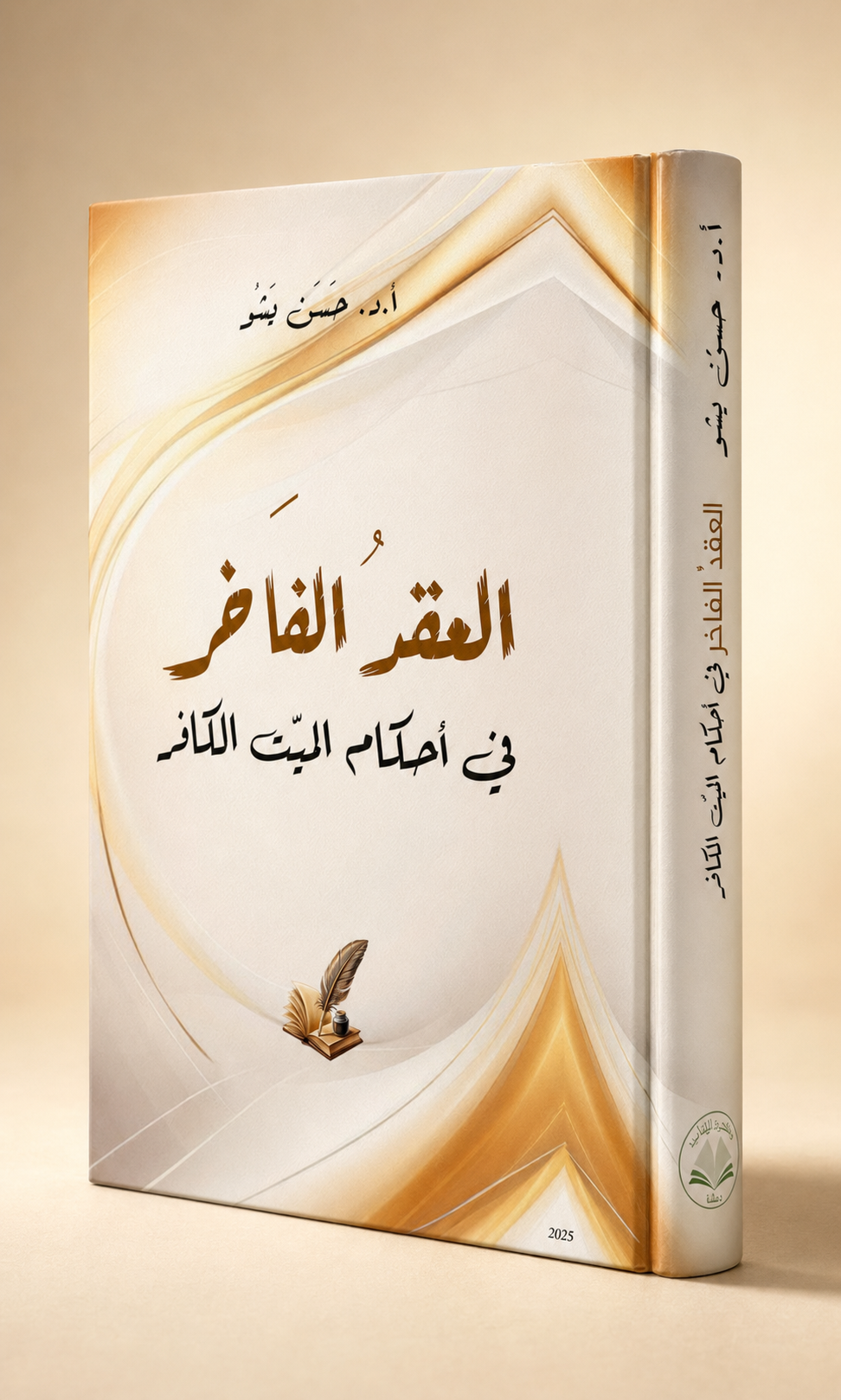
The book “Al-‘Iqd al-Fakhir: Rulings Concerning the Deceased Non-Muslim” by Professor Hassan Yachou represents an extensive jurisprudential attempt to collect the rulings related to non-Muslims in cases of illness, dying, death, and their related religious, social, criminal, and financial effects. The book does not stop at the ritual rulings related to the funeral, but rather moves from them to issues of covenant, security, human dignity, the sanctity of corpses, retribution, blood money, inheritance, and atonement.
The importance of the book stems from the fact that it deals with a topic whose issues are not usually gathered in one jurisprudential chapter. The researcher into the rulings on the funeral of a non-Muslim often needs to refer to books on funerals, doctrine, crimes, religious duties, biographies, the rulings of the people of the Dhimmah, the jurisprudence of minorities, and contemporary calamities. The author has tried to combine this disparate material into a single structure that allows the reader to see the relationships between its various issues.
In terms of its subject matter, the book belongs to comparative jurisprudence, but it does not limit itself to presenting sectarian statements in the abstract. The author brings up contemporary social realities, especially what occurs in multi-religious societies, in families whose members differ in religious affiliation, in countries where Muslims live as minorities, and in professional environments that bring Muslims and non-Muslims together in extended daily relationships.
This reading should not be treated as an independent fatwa on the issues discussed in the book. It is an introductory and analytical study that conveys the author’s direction, explains the structure of his arguments, compares some of the statements he mentioned, and shows the strengths and problems in his formulation. As for applying a specific ruling on a specific incident, it still requires referring to qualified scholars and to the national laws regulating funerals, cemeteries, and dealing with corpses.
The identity and scope of the book
The book's title carries a heritage composition with rhetorical and jurisprudential significance. The word “contract” suggests gathering disparate issues into one thread, as if the chapters and research were beads organized into an integrated scientific contract. Describing it as “luxurious” reflects the author’s desire to present a broad study that goes beyond quick, partial answers to building a comprehensive reference.
The title uses the phrase “deceased non-Muslim” as an inherited jurisprudential term, not an everyday social description intended to disparage anyone. However, the sensitivity of this term in the contemporary context requires that the author explain from the beginning its terminological scope, and show the difference between its use in ancient sections of jurisprudence and its use in modern civil and legal discourse.
A distinction must also be made between giving a general description of a faith or group, and judging a specific person as having left Islam. This distinction is not only a linguistic issue, because the description of a person in jurisprudence has implications related to marriage, inheritance, sacrifices, funerals, burials, and so on. This is why the author did well to make defining the term a necessary introduction before entering into the detailed rulings.
The book, according to the version being read, contains eighteen chapters and is based on one hundred and seventy-six sources and references. This volume reflects the breadth of the material collected by the author, and also indicates that the book does not deal with a limited calamity only, but rather attempts to establish a comprehensive conception of what precedes death, what occurs after it, and what continues after it.
The context that produced the book
The book starts from a realistic incident that raised questions about attending a non-Muslim funeral, reading the Qur’an in its context, and the dividing line between human sympathy and participation in religious rituals. This incident prompted the author to expand the question. He did not limit himself to judging the act that occurred, but rather returned to the principles of jurisprudence from which the issue stems.
The original incident gives the book a distinctly practical feel. The author does not write in a theoretical vacuum, but rather responds to a need that may face the imam, the preacher, the family, the employee, the neighbor, or the Muslim residing in a multi-religious society. This connection to reality explains the many questions with which the author opens some of his discussions, and it also explains his transition between the legal ruling and the moral and social dimension.
However, moving from a partial study to a general study requires a great deal of editing. What is permissible in an emergency situation may not be permissible in a normal situation, and what concerns a relative may not apply to a foreigner, and what relates to a holder of a covenant and security does not necessarily match what is stated in texts that speak of an actual situation of war. The book has drawn attention to many of these differences, although some of them still require further clarification.
The context of the composition also reveals that funeral issues are no longer an internal religious matter separate from the rest of society's institutions. A person's death may occur in a hospital, or it may be undertaken by a municipality, funeral company, or consulate, and burial, autopsy, and transportation procedures may be subject to binding laws. Therefore, contemporary jurisprudential research needs constant dialogue with law, forensic medicine, public administration, and health professions ethics.
The central problem of the book
The major problem is determining what a Muslim is permissible to do towards a non-Muslim during illness, dying, and death, and what is forbidden due to the specificity of Islamic rituals. The book does not address this problem with one comprehensive answer, but rather breaks it down into a group of cases whose rulings differ according to their nature and purposes.
The internal structure of the book is based on an important distinction between human right and religious ritual. Visiting the sick, consoling his family, preserving his body, and burying it when there is no one to take care of it can fall under the heading of righteousness, fulfilling covenants, and preserving dignity, while funeral prayers, afterlife supplications, and burying the dead in Muslim cemeteries remain rituals with specific provisions.
The book adds to this distinction the element of the relationship that exists between the Muslim and the deceased. The ruling may be affected by the fact that the deceased was a father, mother, husband, or child, or a neighbor, colleague, or friend, or a person with whom the Muslim shared a covenant and security bond. In this way, the author does not make religious difference the only factor in building governance, but rather includes kinship, neighborhood, professional relationship, peace, war, and necessity.
The issue of the purpose of the action also arises in the book. Attending a funeral with the intention of consoling the family is not the same as performing a religious ritual, covering the body is not the same as devotional shrouding, cleaning it when necessary is not the same as washing the dead Muslim, and visiting the grave for consideration is not the same as visiting it to pray for the dead. Editing the objectives is one of the most important keys to understanding the author’s preferences.
General structure of classes
The first chapters begin by establishing the concepts upon which the rest of the rulings will be built, especially the concept of atonement, the difference between the general ruling and the specific ruling, and the meaning of the words dhimma, covenant, and security. It appears from this arrangement that the author realizes the danger of moving to the rulings on death and funeral before verifying the jurisprudential description of the person.
Then the book moves to the advanced stages of the patient's life, examining his clinic, prayers for him, and the conditions of the dying. After that, it gets into the core of the rulings on funerals, and deals with washing, shrouding, prayer, funeral, burial, cemeteries, visiting graves, condolences, and reading the Qur’an.
The author is not satisfied with the ritual aspect, but rather devotes a chapter to the sanctity of the corpse and its mutilation, which is a chapter of great moral and legal value. Then it moves to the criminal and financial consequences of murder and death, examining retribution, blood money, inheritance, and atonement.
This arrangement gives the book a rare comprehensiveness, but it presents the author with a methodological challenge. The first topics are closer to the jurisprudence of worship and social relations, while the last chapters belong to crimes and religious duties. It would have been useful for the book to include a systematic introduction explaining the reason for this expansion and how its sections relate to each other.
Research and reasoning methodology
The author adopts an approach based on asking the question, then collecting jurisprudential texts, monuments, and sayings, then discussing them and weighing between them. He makes use of sources of interpretation, hadith, explanations of the Sunnah, and books of ancient and contemporary doctrines and fatwas. He also studies the jurisprudence of minorities and calamities related to Western societies in his subject.
Maliki jurisprudence appears clearly in the book, which is understandable given the author's scientific environment, but the research is not limited to the Maliki school of thought. The author presents the sayings of the Hanafi, Shafi’i, Hanbali, Dhahiri, and others, and sometimes invokes contemporary jurisprudential trends that seek to reread some issues in the light of citizenship and legal equality.
The abundance of sources gives the book rich material, but requires a careful distinction between their grades. Modern texts are not in one rank, and the ancient sayings of jurists are not binding outside of their historical contexts, and contemporary fatwas differ according to the environments and events in which they were issued. Hence, weighting should be based on the weight of evidence, not on the abundance of statements alone.
The research includes preaching and moral discourse, especially in talking about mercy, fulfillment of the covenant, the danger of atonement, and the sanctity of the corpse. This dimension gives the book a human warmth, but in the academic edition it requires a degree of separation between the language of the sermon and the language of analysis, so that the reader knows where the transmission ends, where the discussion begins, and where the author’s choice rests.
Atonement as an introduction to rulings
The author devoted a chapter to adjusting the issue of atonement, because subsequent rulings depend on determining the religious affiliation of the deceased. He emphasizes that atonement is neither a passing word nor a ruling available to everyone, but rather a dangerous legal description that has implications affecting blood, money, marriage, inheritance, funeral and burial.
The book distinguishes between saying that an action or a statement is considered blasphemy in the general ruling, and applying this ruling to a specific person. A person may make a very dangerous statement when he is ignorant of its truth, or interprets it, or is forced to do so, or does not intend its meaning, or the evidence does not reach him in any significant way. Therefore, the presence of the phrase or verb is not sufficient for the final judgment on the specific.
The author stresses the necessity of fulfilling the conditions, the absence of impediments, and the establishment of evidence, and that only established, qualified scholars can undertake this topic. This rule gains practical importance in funeral cases, because haste in atonement may lead to a Muslim being deprived of prayer and burial in Muslim cemeteries, or to the disintegration of his family and the rights of his heirs based on an incorrect ruling.
This chapter represents a protective barrier in the structure of the book. Before asking the reader about washing or praying for a non-Muslim, the author asks him to make sure that the description itself is proven in a reliable way. Deepening this chapter and linking it to contemporary examples would make the book more capable of confronting uncontrolled atonement discourses.
Jurisprudential terms and transformations of the modern state
The book explains the concept of “dhimmah” as indicative of covenant, right, security, and guarantee. In the historical jurisprudential structure, the holder of the obligation is a person who resides in the land of Islam under a contract that grants him protection and specifies his rights and obligations. Some contemporaries have tried to bring this concept closer to nationality or citizenship, but the correspondence between them is not complete.
Modern citizenship is based on general legal equality between citizens, while the dhimmah contract arose in a historical system with its own political, financial, and religious structure. Therefore, it is not correct to automatically transfer its detailed provisions to the modern state, nor is it correct to ignore the values it carried, such as the obligation to fulfill covenants, the prohibition of aggression, and the protection of life, money, and honor.
As for the “Mustamin” in jurisprudential usage, it is someone who entered a Muslim country in temporary safety, while “Al-Mu’ahid” refers to someone with whom the Muslims are bound by a significant treaty. These concepts can illuminate provisions for protection and fulfillment of obligations, but they need contemporary adaptation that takes into account visas, residency, nationality, international agreements, and criminal laws.
The term “military” is the term most in need of caution. It is not permissible to apply it to every non-Muslim or to every citizen belonging to a different country, nor should it be used by individuals or groups according to their whims. The distinction between peace and war in the modern state is governed by law, public authority, and international relations, and is not an individual decision that results in the loss of people’s sanctity.
Human dignity and covenant
The author bases an important aspect of his arguments on the dignity of the human being as a human being. It brings to mind that the Prophet, peace and blessings be upon him, attended the funeral of a Jew and pointed out that it was a human soul. It is understood from this that death does not turn the human body into something that is permissible for abuse, and that religious difference does not nullify the basis of protection and concealment.
The book links dignity with covenant and security. If the non-Muslim during his life was protected in person, money, and honor, then the requirement of loyalty is that his body should not turn into a place of neglect or tampering after his death. From this standpoint, the author bases his opinion on the permissibility of Muslims intervening to wash the body, cover it, or bury it when its family and those responsible for it are absent.
The book cites historical examples of protecting non-Muslims, caring for the weak and the elderly, and releasing prisoners from them. The purpose of these models is to prove that the covenant is not a formal obligation, but rather a moral and legal responsibility. If the group is committed to protecting a person during his life, it must preserve his minimum dignity after his death.
This objective approach is one of the strongest aspects of the book, because it prevents funeral rulings from turning into a harsh discourse divorced from the objectives of Sharia. However, the author needs to adjust the relationship between public dignity and private devotional provisions, so that it becomes clear that maintaining a corpse does not necessarily mean performing Islamic rituals on it.
Clinic for non-Muslim patients
The book distinguishes between a peaceful non-Muslim and someone who is in a state of war and true aggression. It is likely that it is permissible to visit a peaceful patient, especially if he is a relative, neighbor, colleague, or person with whom the Muslim has a significant relationship. The visit then comes under the heading of righteousness, benevolence, and performance of human rights.
The author cites the visit of the Prophet, may God bless him and grant him peace, to the Jewish boy, and the opportunity that the visit brought for a kind word and a call for wisdom. However, the purpose of advocacy should not turn the moment of weakness and illness into pressure on the patient, but rather take into account his dignity, psychological state, and the rights of his family, and offer him what suits his situation with kindness and respect.
The book permits supplication for a living non-Muslim for guidance and improvement of his condition, and also presents the statement that it is permissible to pray for his survival if there is a significant interest. What is meant here is the supplication related to life, guidance, well-being, and worldly interests, not the rulings related to someone who died in a state other than Islam.
This issue is of particular importance in hospitals and care institutions, where Muslims work as doctors, nurses and companions to patients of multiple faiths. The direction of the book emphasizes that religious difference does not justify professional negligence or human estrangement, but rather health care and professional honesty remain fully obligatory.
Dying and doctrinal questions
The book moves from illness to death, presenting some texts related to death, the isthmus, and the afterlife. This transition requires great sensitivity, because the rulings of this world are based on what is apparent, while the destinies of individuals in the afterlife are due to God’s knowledge, justice, and wisdom.
The author discusses the possibility of offering Islam to a dying non-Muslim if he is in a state that allows understanding and choice, drawing on the story of the Jewish boy. However, the validity of the choice requires that the offer not be accompanied by coercion or exploitation, and that it respect the legal and medical system and the patient’s rights and degree of awareness.
As for the children of non-Muslims, the book presents statements related to their fate, then stops at saying that God knows best what they were doing. He distinguishes between their worldly rulings, which follow their families in the jurisprudential system that it transmits, and the otherworldly rulings that humans do not have the ability to comprehend.
It would have been appropriate for the book to summarize some doctrinal details that do not have a direct impact on funeral rulings, or to devote a separate appendix to them. The main topic is practical jurisprudence, and prolonging the issues of the afterlife may shift the center of gravity away from the questions that the book came to address.
Washing the corpse
The book presents the position of the majority of jurists who prohibit a Muslim from washing a deceased non-Muslim in a devotional manner similar to washing a dead Muslim. Their argument is based on the fact that washing the dead is a funeral rite, and that Islamic rituals are linked to the people of Islam and are not performed on those who died outside their religious group.
In contrast, the author presents an approach that looks at washing from the point of view of cleaning and maintaining the body, not from the point of view of worship alone. If there is no one from the deceased’s family, members of his religion, or competent authorities to take care of him, removing harm from him and preparing him for burial may become a necessary humanitarian act.
The author suggests that it is permissible to wash the person who has pledged his trust and security when there is no one to take care of his body, on the condition that the Muslim does not intend to perform Islamic devotional washing on him. Thus, he distinguishes between the form of the action and its purpose. Some cleaning procedures may be superficially similar, but their judgment may vary depending on intent and context.
This weighting needs a clearer practical protocol in the revised edition. Who decides the absence of the competent authority? Should the family of the deceased, representatives of his religion, or the authorities be contacted first? What are the limits of individual intervention? How are the rules of forensic medicine observed? Answering these questions makes the opinion amenable to disciplined analysis.
Shrouding and covering the body
The disagreement over washing extends to shrouding. Shrouding as a form of worship known at Muslim funerals is linked to specific provisions, while covering the body and protecting it from exposure and insult is a general humanitarian goal that does not depend on religious affiliation.
The author suggests that it is permissible to cover the body of a non-Muslim in a way that preserves it and prepares it for burial if there is no one to take care of it. This does not mean applying all the details of the Islamic shroud, but rather providing the appropriate cover that prevents the body from being exposed and preserves it until it is hidden.
The book quotes some jurists that shrouding a non-Muslim and burying him in the absence of his family is considered an obligation of sufficiency. The idea is that keeping the body uncovered or at risk of being lost harms the dignity of the dead person and society, and that removing this harm is a collective responsibility if the original owner does not do it.
The benefit of distinguishing between “ritual shrouding” and “protective covering” clearly appears here. If the book uses the two terms without explaining the difference, the reader may understand that the author equates the funeral of a Muslim and a non-Muslim. If the purpose and procedure are specified, much of the confusion disappears.
Mixing of bodies
The book deals with the case of the bodies of Muslims being mixed with others and it being impossible to distinguish between them, which is one of the calamities that may occur in wars, disasters, fires, and mass accidents. He presents the opinion of those who believe that everyone should be washed and shrouded, while specifying the intention of worship for Muslims.
This treatment is based on precaution for the right of the Muslim who cannot be assigned, without intentionally performing the ritual on a non-Muslim. The intention is directed towards those who deserve to be judged, while the apparent procedures include everyone due to the impossibility of distinction.
In the modern era, cases of suspicion can be reduced by using forensic identification techniques, DNA analysis, medical and dental records, and fingerprints. Therefore, the jurist should not move directly to the ruling on mixing before exhausting reasonable scientific means that enable verification of identity.
In major disasters, there must be coordination between the legal, medical, judicial and security authorities. Dealing with corpses is not an area of isolated individual diligence, but rather an organized process that protects forensic evidence, preserves the rights of families, and takes into account religious beliefs and health rules.
Praying for the funeral
The book states that the Islamic funeral prayer is not performed over a deceased non-Muslim. It conveys the agreement of the jurists on the origin of the prohibition, and cites the texts they adopted as evidence. It also discusses the story of Abdullah bin Ubayy bin Salul and the narrations related to the Prophet’s prayers, peace and blessings be upon him.
This ruling distinguishes between human compassion and religious ritual. A Muslim may console the family, assist when necessary with civil procedures, and attend the funeral according to the rules, but he does not perform the Islamic funeral prayer for a person who died in a state other than Islam.
The book also addresses the situation of Muslim bodies mixing with non-Muslims and the inability to distinguish. The statement of who is praying is presented to the group with a structure that concerns Muslims alone. The intention here performs the function of specification when it is not possible to determine which body is worthy of prayer.
It would have been useful for the author to differentiate in more detail between simply entering a place where religious ceremonies are being held out of social necessity, and verbal or kinetic participation in the prayer itself. There are many contemporary scenes, and a Muslim may attend a public hall, church, or cemetery without performing the rituals that are held there.
Attending the funeral and conducting it
Attending the funeral of a non-Muslim is one of the most prominent places in which the author tends towards controlled facilitation. It suggests that it is permissible for a Muslim to attend the funeral of his non-Muslim relative, whether he is a father, mother, husband, or child. He also expands the ruling to include a neighbor, colleague, and friend when there is a significant relationship.
The author links permissibility to the deceased being peaceful, and to the purpose being to console his family, fulfill the right of kinship and neighborliness, or unite hearts. Attendance is neither an acknowledgment of a belief that contradicts Islam, nor a participation in religious worship, but rather an expression of human and social loyalty.
The book places restrictions that prevent a Muslim from performing prayers for the dead, repeating doctrinal phrases that he does not believe, or praying for his forgiveness in the afterlife, according to the author’s choice. Attendance is limited to the extent that achieves consolation and preserves the family and community relationship without dissolving religious boundaries.
This view is increasingly important in religiously mixed families and in international business environments. Absolute abstention from attendance may lead to severe estrangement or abuse not required by the texts, while uncontrolled participation may lead to doctrinal confusion. The book attempts to build a middle path between estrangement and dissolution.
Attending places of worship
In the attached copy, a missing phrase appears among the controls for attending non-Muslim funerals, which is the phrase related to attending places of prayer in churches, shops, and the like. It appears from the context that what is meant is not participating in religious prayer, but the text needs an explicit completion to prevent differences in understanding.
Entering a church or ceremony hall does not in itself necessarily equate to participation in worship. A Muslim may enter to offer condolences, to accompany a relative, or to perform an official mission, and then abstain from words and acts of worship that are contrary to his belief. The ruling may vary depending on the nature of the place, the ceremony, and the ability to remain without participating.
Therefore, it is advisable for the book to distinguish between spatial presence, ritual participation, and doctrinal agreement. These are three different levels, and they should not be combined into one ruling. It should also be mentioned that specific facts may require questions from knowledgeable people who understand their details and legal and social context.
This detail protects the Muslim from two opposing parties: It protects him from extremism that severs family ties and legitimate relationships, and also protects him from participating in rituals that are inconsistent with his belief. This budget is consistent with the central vision of the book if it is formulated accurately.
Burial and burial
The book states that every corpse has the right to be hidden, because leaving it uncovered is an insult to the dead and harmful to the living. This general right does not mean unifying the rituals, but rather it means removing the body from the place of exposure and preserving it according to appropriate procedures.
If the deceased's family, representatives of his religion, or competent public authorities are found, they are more likely to undertake his burial. As for Muslim intervention, it is when needed or necessary, and to the extent that it preserves the body and prevents its loss. This exception may not turn into a seizure of the family’s right to choose the ceremonies permitted by law.
The book originally asserts the independence of Muslim cemeteries from non-Muslim cemeteries. This is linked to the specificity of the provisions of burial, supplication, the qiblah, and funeral rites. However, contemporary reality may impose exceptional cases in some countries where independent Islamic cemeteries are not available.
When necessary, the matter should be evaluated by scholars and competent authorities, while searching for the best possible solution, such as allocating a clear section for Muslims within a public cemetery. The existence of a slight hardship is not sufficient to cancel the original, nor is it permissible to ignore the real necessity that may make the alternative impossible.
Exceptional cases in cemeteries
The book discusses the case of a biblical woman who dies while pregnant by a Muslim, which is an ancient issue over which jurists differed regarding the place of her burial due to the combination of the mother’s right and the condition of the fetus. This issue reveals that cemetery rules are not always mechanically applicable.
Book questions
Book Certificate Quiz
Answer every question to earn a verified certificate with a unique serial number.
Related Books
An educational collection of 500 numbered maxims drawn from experience and reflection on faith, character, relationships, trust, disappointment, patience, maturity, speech, self-respect, and the lessons of life, with the clove serving as a metaphor for cleansing the mind.
A foundational legal and educational study of chastity in the Qur’an, Prophetic Sunnah, and Islamic heritage, explaining its objectives and effects while offering practical means to preserve it amid contemporary social and media change.
A rigorous and accessible refinement of Sheikh Yusuf al-Qaradawi’s landmark Fiqh al-Zakat, presenting its principal rulings, contemporary updates, legal objectives, modern measurements, and practical tables for students and researchers in Islamic economics.
A foundational account of critical method in the Islamic scholarly tradition as a tool of renewal and civilizational development, presenting its major forms and forty ethical and methodological principles for objective, constructive criticism.