Al-Mishkat: A Refined Abridgement of Sheikh Yusuf al-Qaradawi’s Fiqh al-Zakat
A rigorous and accessible refinement of Sheikh Yusuf al-Qaradawi’s landmark Fiqh al-Zakat, presenting its principal rulings, contemporary updates, legal objectives, modern measurements, and practical tables for students and researchers in Islamic economics.
Citation preview:
أكاديميحسن يشو (2026). Al-Mishkat: A Refined Abridgement of Sheikh Yusuf al-Qaradawi’s Fiqh al-Zakat. https://www.hassanyachou.org/en/books/كتاب-المشكاة-في-تهذيب-فقه-الزكاة-للشيخ-يوسف-القرضاوي
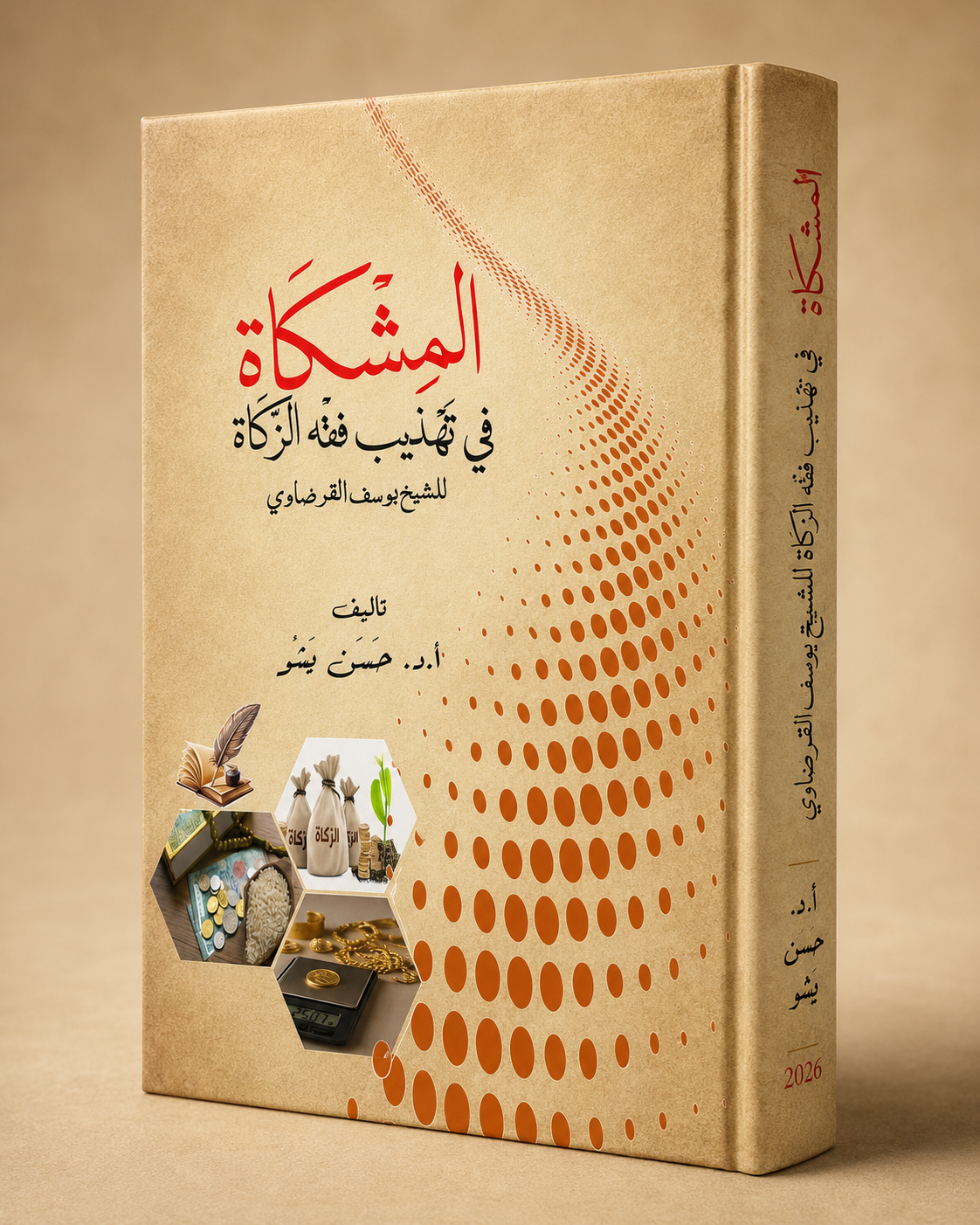
"Al-Mishkat: A Refined Abridgement of Sheikh Yusuf al-Qaradawi’s Fiqh al-Zakat": The heart of jurisprudence and the objectives of legislation are in the hands of the student of knowledge
The book “Al-Mishkat: A Refined Abridgement of Sheikh Yusuf al-Qaradawi’s Fiqh al-Zakat” by Professor Hassan Yachou (edition 2026 AD/1447 AH) represents a methodological masterpiece in the art of “scientific refinement.” The author started from his awareness of the great reference value of Imam Yusuf al-Qaradawi’s encyclopedia “The Jurisprudence of Zakat”, which is considered the book of the century in Islamic jurisprudence and economics, to refine it and bring it closer to students of knowledge, removing from it the long digressions and the high-level, complex disagreements, to present “the essence of jurisprudence” in a noble and smooth style.
Why “Al-Mishkat”? The genius of refinement and modernization
Professor Hassan Yachou's work was not just an obscene abbreviation, but rather a careful editorial work that adhered to the rules of scientific research. The genius of this refinement was evident in:
Filtering and purifying: deleting weak hadiths and lengthy linguistic discussions, being satisfied with the doctrines of the Sunnis and the community, and removing what has no practical fruit in our time.
Contemporary jurisprudential update: The author included the new jurisprudence of Imam Al-Qaradawi that was established in his late fatwas (such as zakat on shares), so that the material keeps pace with developments.
Mathematical accuracy and modern standards: Al-Muhadhdhab worked on converting traditional measures and weights (such as sa’ and wasq) into accurate modern standards. He set the nisab at 85 grams of gold, and the nisab for crops at approximately 647 kilograms, which relieves the student of knowledge of difficulty in calculation.
Cognitive geometry: The book is provided with explanatory tables to simplify livestock shares and their calculations, which helps the student to memorize and comprehend quickly.
The Philosophy of Zakat: It is not just a tax, but rather a divine system. The book clearly highlights how Zakat in Islam is not just a voluntary charity or temporary aid to make ends meet, but rather a “known right” aimed at eliminating poverty from its roots, and permanently enriching the poor. The book has shown that Islamic economics is unique in four characteristics: a divine, moral, human, and moderate economy.
Selected jurisprudential pearls for the seeker of knowledge
The book delves into the subject of dispute in major jurisprudential issues, including:
Zakat on the wealth of a child and an insane person: The book discussed the dispute carefully, giving preference to the popular opinion that zakat is obligatory on their wealth. Because zakat is a right related to growing wealth, and a consolation for the poor, and it is not waived due to childhood or insanity, and the guardian is required to pay it.
Zakat on paper money: The book settled the controversy over compulsory paper money, stressing the obligation of zakat on it because it has become a tool of exchange and evaluation and carries purchasing power that takes the place of gold and silver.
Zakat on permissible jewelry: Review the evidence for what is obligatory and what is not, to make it likely - based on the objectives - that zakat is not obligatory on women’s jewelry intended for normal use. Because it has ceased to be “developing money” and has become like clothes, except for what is permissible to the point of extravagance or intended to be hoarded.
Zakat on crops and fruits: He raised a high degree of disagreement regarding the types of zakat, choosing the doctrine of Abu Hanifa (that zakat is obligatory on everything that the land produces for the purpose of growth), but he disagrees with him in stipulating the “qusab”, as he favored the requirement of reaching the quorum (5 awsq) to protect small farmers.
A conclusion worthy of the researchers' passion
The book “Al-Mishkat” is not just a jurisprudential summary, but rather a training course for the seeker of knowledge in the jurisprudence of budgets, the jurisprudence of objectives, and the graduation of branches into principles. It puts in your hands the pure secrets of Islamic financial legislation, so that you can see how Sharia balances the right of God, the interest of the poor, and the growth of the wealth of the rich, in divine legislation that does not come to falsehood from before it or from behind it.
Book questions
Book Certificate Quiz
Answer every question to earn a verified certificate with a unique serial number.
Related Books
A comparative legal study of rulings concerning non-Muslims before death, during the final illness, and after death, covering visitation, funeral care, burial, condolences, bodily dignity, criminal liability, blood money, inheritance, and expiation across classical and contemporary contexts.
An educational collection of 500 numbered maxims drawn from experience and reflection on faith, character, relationships, trust, disappointment, patience, maturity, speech, self-respect, and the lessons of life, with the clove serving as a metaphor for cleansing the mind.
A foundational legal and educational study of chastity in the Qur’an, Prophetic Sunnah, and Islamic heritage, explaining its objectives and effects while offering practical means to preserve it amid contemporary social and media change.
A foundational account of critical method in the Islamic scholarly tradition as a tool of renewal and civilizational development, presenting its major forms and forty ethical and methodological principles for objective, constructive criticism.