
Moderation: Features, Principles, and Caveats
A foundational study of Islamic moderation as a safeguard for the community, defining its legal principles, warning against excess and negligence, and presenting Sheikh Yusuf al-Qaradawi as a major contemporary model of the balanced school.
Citation preview:
أكاديميحسن يشو (2026). Moderation: Features, Principles, and Caveats. https://www.hassanyachou.org/en/books/كتاب-الوسطية-معالم-وضوابط-ومحاذير
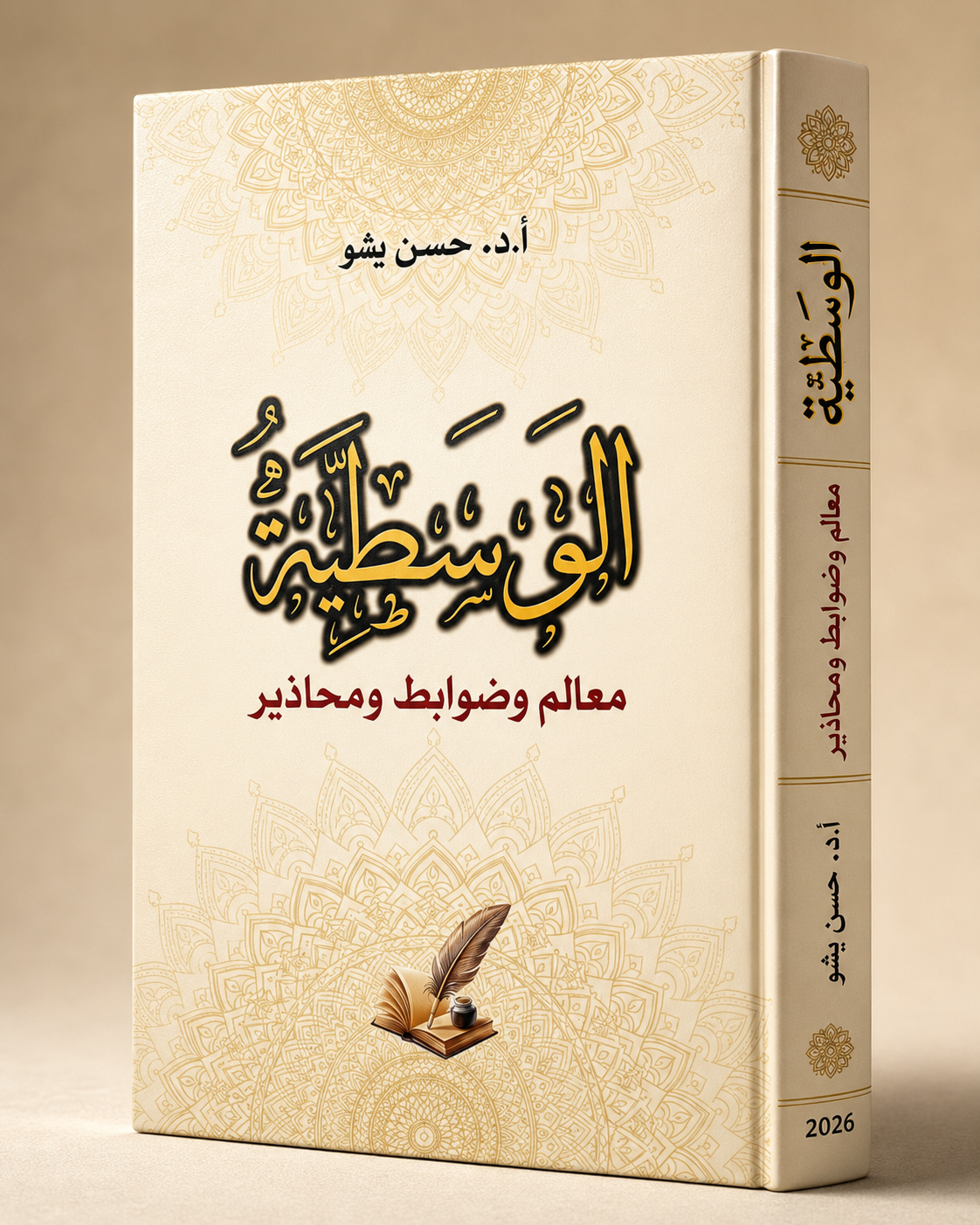
The book “Moderation: Features, Principles, and Caveats”: The compass of the Muslim mind in times of fragmentation
The book “Moderation: Features, Principles, and Caveats” by Professor Hassan Yachou, published in 2026 AD (1447 AH) by the Student Library in Oujda, represents a very important intellectual and original document. This book was born out of the International Academy of Moderation Scholars. To serve as the opening lecture of its thirteenth international conference, carrying the mission of correcting the course and renewing the discourse. The author began his book with an expressive dedication to the spirit of the scholar Sheikh Yusuf al-Qaradawi, describing him as “the standard-bearer of facilitation in the modern era,” and “the writer of jurists” who raised the banner of the moderate school.
The book starts from a universal truth and established legitimacy. It is that God created the universe and ruled it without variation, and that His religion and system are in harmony with this universal rule so that the “moons of mediocrity” radiate from them. The author attributes most of the calamities that befell the Islamic nation to the lack of this moderation, and the spread of extremism and extremism. Which makes it necessary to return to it as a civilizational and fateful choice for the safety of Islamic work.
The author divided his book into three main sections, which take the reader on a gradual, authentic journey:
The first topic: The reality of moderation and the consequences of its absence
In this study, the author digs into the linguistic and terminological roots of the concept of moderation, warning of the profound imbalances that result from its loss:
Rooting the concept: Linguistically, moderation means justice, virtue, benevolence, and mediation between two parties, and terminologically it is moderation between excess and negligence in understanding, perception, judgment, behavior, and approach to life.
The ruling balance and intentional guidance: The book confirms that moderation is the balance that prevents tyranny (excessiveness) and loss (negligence), and it is the “intended guidance” represented in the life of the Prophet, peace and blessings be upon him, which embodies the perfect balance between materialism and spirituality.
Distortions of the absence of moderation: The author keenly monitors how the absence of moderation thought has led to serious imbalances, including: the mind’s obsession with the explicit text or vice versa, the dominance of fragmentation over coalition, and exaggeration in expanding the circle of prohibition.
Violence and the jurisprudence of crises: It sheds light on the scourge of violence resulting from “foolish external jurisprudence,” which produced a defect in the “jurisprudence of jihad” (by pointing weapons at the people of the qiblah), a defect in the “jurisprudence of changing evil” (by causing greater evils), a defect in the “jurisprudence of rebelling against the ruler” (which led people to sources of strife), and a catastrophic defect in the “jurisprudence of atonement” that affected scholars and the general public of the nation.
The second section: features, controls, and caveats
Professor Hassan Yachou in this study sets out a precise geometry for the middle approach; So that it does not become a fluid or loose term:
The supremacy of the Sharia text: It establishes a strict rule that “there is no moderation in the source of the text,” and that moderation must be carried out in accordance with the Sharia and not contradict its explicit texts.
Connection to objectives: Moderation is clearly evident in achieving and multiplying interests, and preventing or reducing harms, and objectives are among the most prominent features of the moderate school, which does not read texts in isolation from their objectives.
Delicate balances: Moderation is evident in the balance between the constant and the variable, between individualism and collectivism, between rationality and emotionality, and the combination of authenticity and modernity.
The facilitation approach: The author raises the slogan: “The principle in fatwas is facilitation and in preaching is preaching,” explaining that mitigation and ease of assignments are among the goals of the wise legislator to ensure continuity and non-interruption.
Attitude toward the other: The book highlights the human dimension of moderation through tolerance and coexistence with others, rejection of coercion in religion, fairness to the People of the Book, and treating them in the best way.
The third topic: Moderation when it raises its banner (Sheikh Al-Qaradawi)
The author devotes this topic to studying the moderate thought of Imam Yusuf al-Qaradawi, as it is the contemporary and applied model for this school:
Path and influence: Follows the factors that shaped Sheikh Al-Qaradawi’s moderation. Starting from his nature, his Al-Azhar environment, his influence by the “Al-Manar” school, and his combination of the schools of Al-Ghazali and Ibn Taymiyyah.
Intermediate positions: It explains how Al-Qaradawi stood in the middle between closed sectarianism and non-sectarianism, between the excesses and estrangements of Sufism, between sanctifying heritage and abolishing it, and between extremism in takfir and leniency with apostates.
The Thirty Milestones of Moderation: The book reviews the milestones formulated by Al-Qaradawi, including a comprehensive understanding of Islam, renewal from within, fairness to women, care for the family, establishing a just state, strengthening the nation’s economy based on Sharia jurisprudence, and pride in belonging to the Islamic nation.
Conclusion and final statement
The book concludes with a report of conclusive findings; The most important of which is that moderation is not a doctrine of jurisprudence or a political party, but rather an integrated “way of life,” and it is the evidence of strength, the center of unity, and the lifeline for the nation. The author also includes the “final statement” of the thirteenth international conference of the World Academy of Moderation Scholars (May 2026), which emphasized that moderation is a comprehensive identity and a safety valve, while emphasizing the necessity of conscious renewal of religious discourse, and investment in the digital space to spread moderation, and legitimate and humanitarian solidarity with the Palestinian cause and those stationed in Gaza.
Book questions
Book Certificate Quiz
Answer every question to earn a verified certificate with a unique serial number.
Related Books
A comparative legal study of rulings concerning non-Muslims before death, during the final illness, and after death, covering visitation, funeral care, burial, condolences, bodily dignity, criminal liability, blood money, inheritance, and expiation across classical and contemporary contexts.
An educational collection of 500 numbered maxims drawn from experience and reflection on faith, character, relationships, trust, disappointment, patience, maturity, speech, self-respect, and the lessons of life, with the clove serving as a metaphor for cleansing the mind.
A foundational legal and educational study of chastity in the Qur’an, Prophetic Sunnah, and Islamic heritage, explaining its objectives and effects while offering practical means to preserve it amid contemporary social and media change.
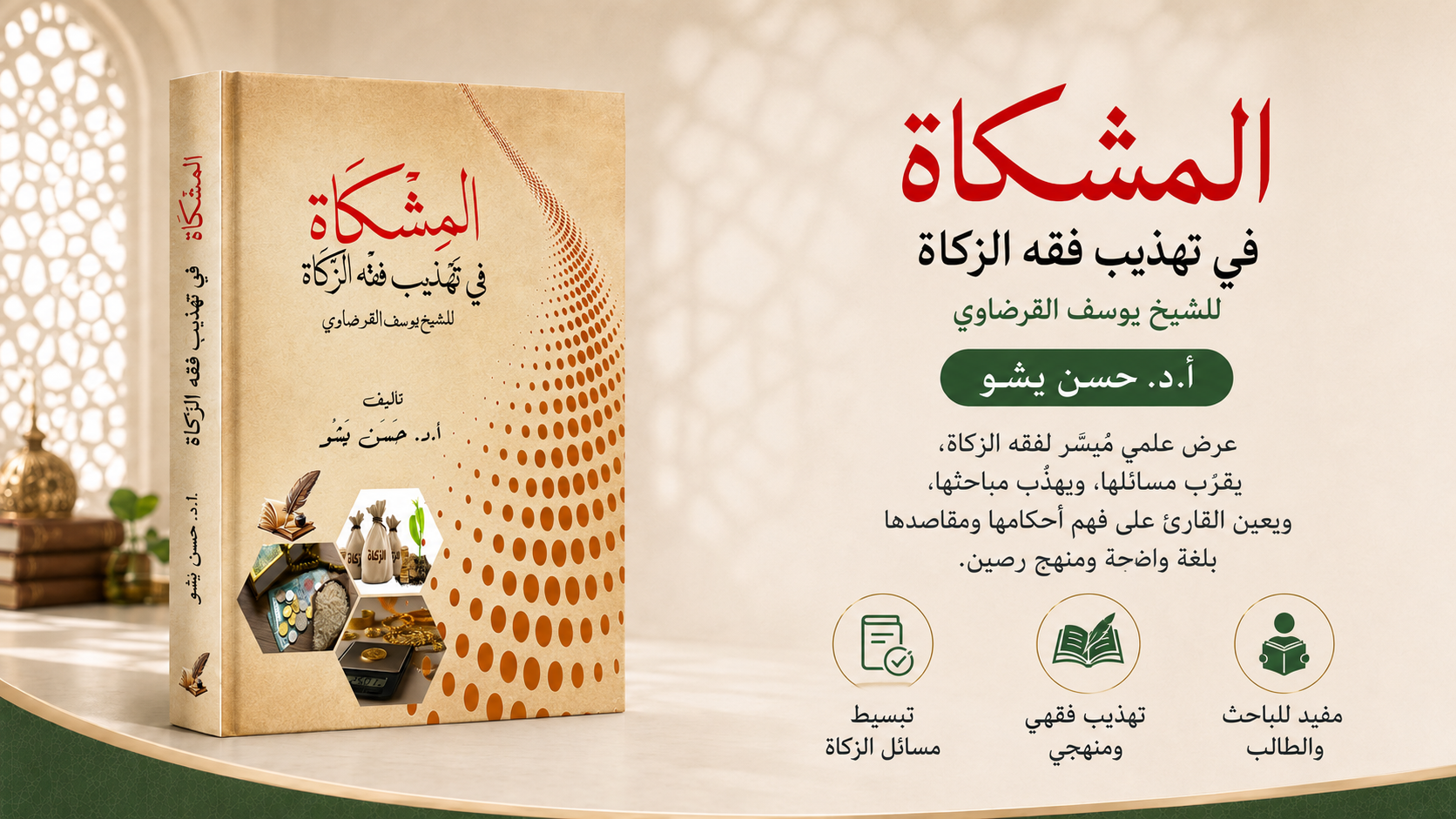
A rigorous and accessible refinement of Sheikh Yusuf al-Qaradawi’s landmark Fiqh al-Zakat, presenting its principal rulings, contemporary updates, legal objectives, modern measurements, and practical tables for students and researchers in Islamic economics.