
History of Islamic Jurisprudence: Its Origins and Development Through the Ages
A structured study of the origins and historical stages of Islamic jurisprudence, from pre-Islamic Arabia and the age of Revelation to its schools, objectives, distinctive features, renewal, and relationship with modern statutory law.
Citation preview:
أكاديميحسن يشو (2026). History of Islamic Jurisprudence: Its Origins and Development Through the Ages. https://www.hassanyachou.org/en/books/كتاب-تاريخ-الفقه-الاسلامي-دراسة-في-نشاة-الفقه-وتطوره-عبر-العصور
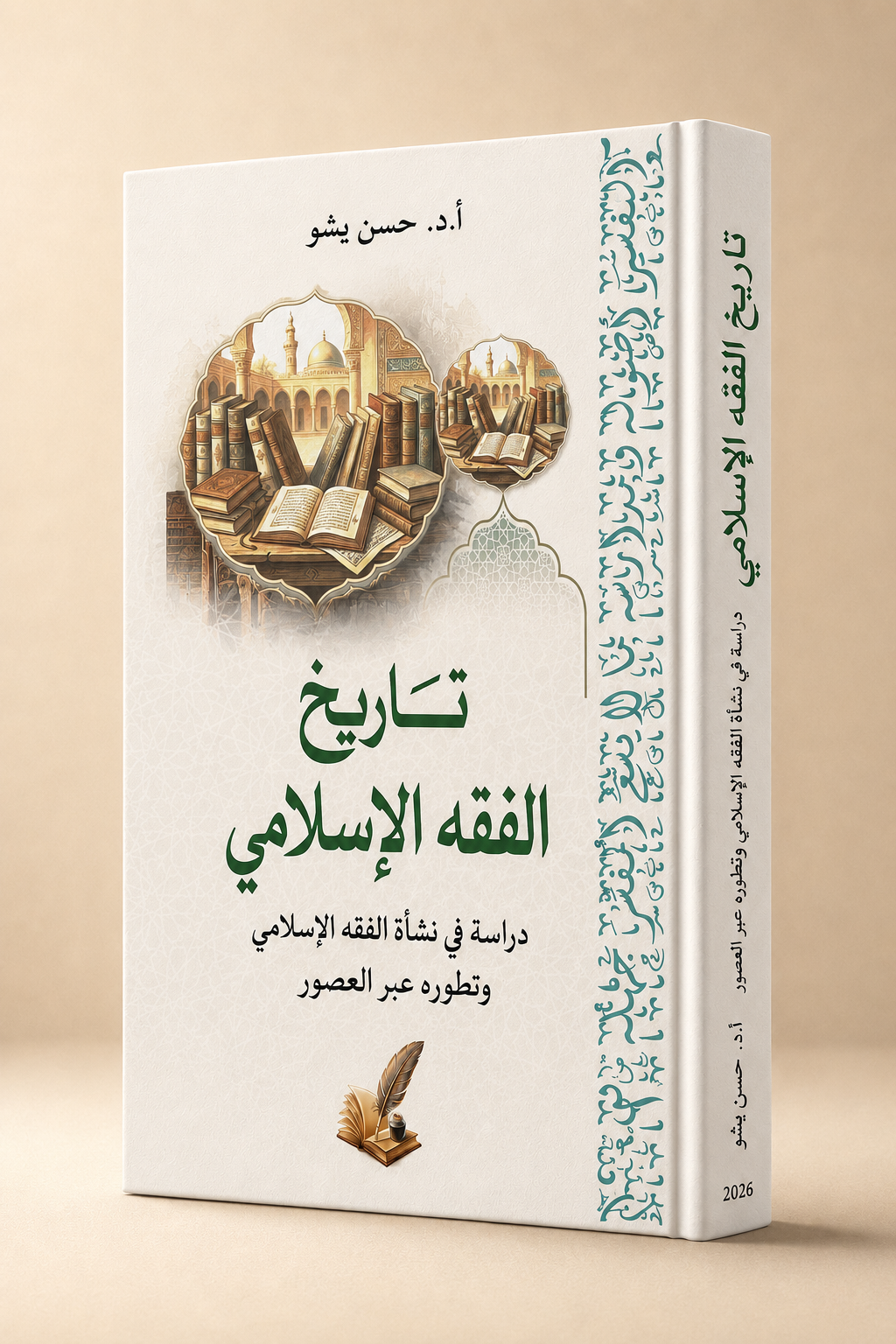
The book “History of Islamic Jurisprudence: Its Origins and Development Through the Ages”, by Professor Hassan Yachou, constitutes a qualitative addition and a solid academic reference to the jurisprudential and historical library. This work represents the result of the author’s teaching experience and knowledge accumulation in academic classrooms, starting with the Qatar Foundation and ending with Mohammed I University in Morocco. This book came in response to an urgent need to fill the gap in the methodological approaches that establish the origins and development of jurisprudence, going beyond the abstract historical narrative to a deep jurisprudential analysis that links rulings to their environment and time.
The book begins with a precise conceptual establishment of the term “history of Islamic jurisprudence,” defining it as the science that investigates the origins of jurisprudence, its schools, its imams, the reasons for their differences, and the development of schools of thought throughout the ages, while recalling the historical circumstances influencing this path. The author emphasizes the centrality of this science in understanding Sharia law. It is not just an intellectual luxury, but rather an inevitable necessity (fard kifaya) that enables the student to comprehend terminology, follow the paths of jurists in deduction, and realize the factors that contributed to the prosperity of jurisprudence or those that led to its stagnation. This science also represents an impenetrable wall to refute the suspicions of Orientalists, and a tool for understanding the vitality of Islamic jurisprudence and its ability to keep pace with developments by deriving its material from combined sciences such as the sciences of the Qur’an, Hadith, biography, and the principles of jurisprudence and history.
The author did not neglect to trace the historical roots of this science, pointing out that the first indications for writing down the history of jurisprudence go back to the efforts of the Moroccan scholar Muhammad al-Hajwi al-Tha’alabi in his book “The Sublime Thought,” and the Levantine scholar Muhammad al-Khudari Bey in “The History of Islamic Legislation,” who laid the first building blocks for this art at the beginning of the twentieth century, paving the way for a long series of works that the book reviewed in a comprehensive bibliographic glossary. Professor Hassan Yachou has adopted a hexagonal systematic division of the roles of Islamic jurisprudence, beginning with the era of legislation (the Prophet’s mission), then the era of the Companions and Rightly Guided Caliphs, followed by the era of the Successors, then the era of codification and diligent imams, after which jurisprudence enters the era of stagnation and imitation, arriving at the present era, which is considered the era of revival and renewal.
Before delving into the details of these eras, the book provides a comprehensive conceptual foundation of the word “jurisprudence” linguistically and idiomatically. Linguistically, jurisprudence is about precise and deep understanding. In legal terminology, the term has undergone an important semantic development. In the first era of Islam, “jurisprudence” included the entire religion with its beliefs, morals, and practical rulings, which is what Imam Abu Hanifa expressed as “knowing the soul what it has and what it owes.” But with the development and specialization of sciences, the term “jurisprudence” was designated in the terminology of later scholars as “the knowledge of practical legal rulings acquired from their detailed evidence,” and this is the definition with which scholars avoided confusion between jurisprudence and other sciences such as doctrine and the principles of jurisprudence.
The book clearly highlights the features and characteristics of Islamic jurisprudence that make it unique from positive laws. It is a jurisprudence of divine origin, characterized by balance, comprehensiveness and moderation, and its rulings are subject to reasonableness that takes into account the interests of the people. Islamic jurisprudence is also characterized by realism, humanity and universality, and combines worldly and afterlife punishment, relying on self-censorship stemming from faith. The greatness of this jurisprudence is evident in its breadth and flexibility, which comes from its consideration of necessities and excuses, and the susceptibility of its texts to multiple understandings, and the change of fatwas with changes in time and place, which makes it valid for all times and places, and a cultural pride for Muslims that even fair-minded orientalists like Santillana praised. The author is keen to differentiate carefully between “Sharia” that is fixed, sacred, and binding on everyone, and “Jurisprudence,” which represents human effort in understanding this Sharia, which is variable and accepts right and wrong.
In a smart methodological move, the author paves the way for talking about the era of legislation by studying “the condition of the Arabs before Islam.” He explains that choosing the Arabian Peninsula to be the cradle of the message was not a coincidence, but rather due to great divine wisdom. The Arabs, despite their religious ignorance (which was represented by polytheism and idolatry) and their political backwardness, had noble innate qualities such as courage, generosity, and loyalty, and possessed a strong language and a charming statement, in addition to a strategic geographic location far from the complexities of the deviant philosophies and ideologies that prevailed in the Persian and Roman empires. The book reviewed detailed examples of pre-Islamic customs and legislation in marriage (such as the marriage of a man who is afflicted and arrogant), divorce, separation (such as zihar and al-Ilaa), inheritance, and financial transactions (such as usury and deceived sales), showing how Islam intervened to abolish the corrupt ones, amend what needs to be corrected, and establish the righteous that is compatible with the purposes of Sharia law and human justice.
The book reaches its analytical climax in detailing “the first period: the era of legislation,” which is the era of the prophetic message and mission extending for twenty-three years (between Mecca and Medina). This era is considered the most important of all jurisprudential roles. Because it is the era in which revelation was revealed, divine legislation was completed, and the rules of religion were established. The author divides this era from a legislative standpoint into two complementary phases: “Meccan legislation,” which extended for thirteen years, and focused mainly on building pure doctrine, correcting concepts, establishing good morals, and combating vices, with few and general practical legislation appropriate to the state of weakness and building the foundation. The Meccan Qur’an was characterized by the shortness of its verses and the intensity of its speech to deter and rebuke.
As for "civil legislation", which began with the migration and continued for ten years, it witnessed the establishment of the Islamic state and the building of society. At this stage, detailed legislation regulating family affairs, financial transactions, crimes, borders, the judiciary, and international relations in peace and war came down, and even addressed internal political issues such as the phenomenon of hypocrisy. The book confirms that legislative authority in this era belonged to God alone, and that the Prophet, peace and blessings be upon him, was a conveyor and clarifier of what was revealed to him, whether through the Holy Qur’an or through his purified Sunnah, which is considered the second source of legislation. Legislation was provided either in response to facts and events, or in response to questions that were difficult for the Companions, so that the Prophet, peace and blessings of God be upon him, was the sole authority in clarifying what is permissible and what is forbidden, confirming and detailing what was outlined in the Qur’an, or an independent legislator with rulings that were not stated in Qur’anic verses.
Book questions
Book Certificate Quiz
Answer every question to earn a verified certificate with a unique serial number.
Related Books
A comparative legal study of rulings concerning non-Muslims before death, during the final illness, and after death, covering visitation, funeral care, burial, condolences, bodily dignity, criminal liability, blood money, inheritance, and expiation across classical and contemporary contexts.

An educational collection of 500 numbered maxims drawn from experience and reflection on faith, character, relationships, trust, disappointment, patience, maturity, speech, self-respect, and the lessons of life, with the clove serving as a metaphor for cleansing the mind.

A foundational legal and educational study of chastity in the Qur’an, Prophetic Sunnah, and Islamic heritage, explaining its objectives and effects while offering practical means to preserve it amid contemporary social and media change.
A rigorous and accessible refinement of Sheikh Yusuf al-Qaradawi’s landmark Fiqh al-Zakat, presenting its principal rulings, contemporary updates, legal objectives, modern measurements, and practical tables for students and researchers in Islamic economics.